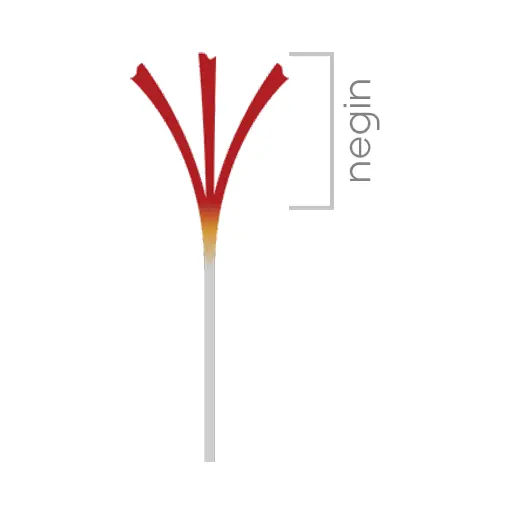
Esfedan Grade 1 Negin Saffron is supplied in a 125 g commercial format for applications that require visible saffron filaments rather than a ground ingredient. Negin consists of developed red stigmas from Crocus sativus, with the lighter yellow or white style removed during processing. Its relatively long, all-red filaments distinguish it from the shorter cut structure commonly associated with Sargol.
Laboratory analysis records a Crocin value of 240–275, indicating the product’s measured colouring performance under the stated test conditions. Safranal is reported at 28–50 and Picrocrocin at 65–100, providing analytical indicators related to saffron aroma and flavour. The tested moisture and volatile matter content is 7.18%, compared with the product’s specified maximum of 10%. No artificial colorants were detected in the reported test.
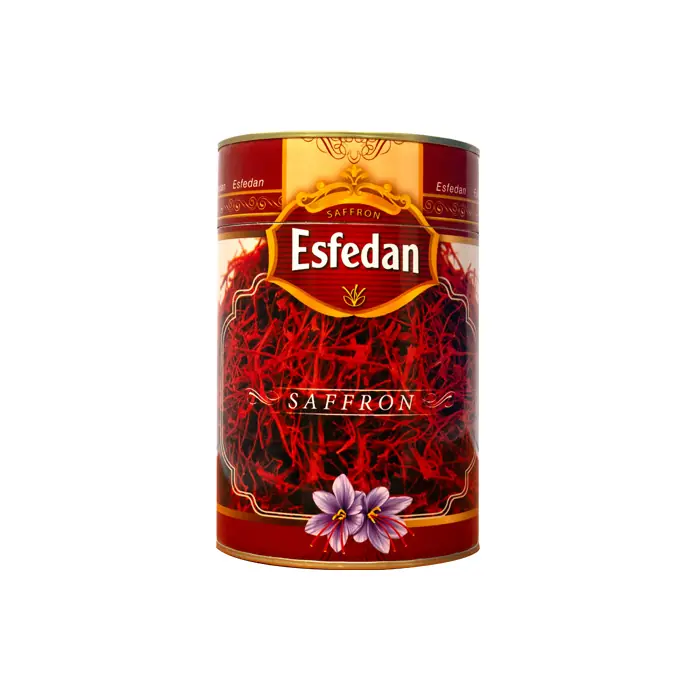
The product is presented in a cardboard can placed inside a cardboard box. Its 125 g net weight and documented master-box and carton configuration make it suitable for professional kitchens, foodservice requirements and commercial saffron orders where packaging and logistical information must be reviewed before purchase.
This product retains the visible structure of saffron threads and can be used whole when presentation matters or crushed before infusion when more even extraction is required. Other weights and packaging formats within the same classification can be compared in the Negin saffron category. Buyers evaluating additional commercial grades and formats can also explore the complete saffron bulk range.
For a separate review of the potential effects of saffron examined in relation to different health conditions, read the Saffron Benefits article.
Packaging Specifications
125 g Packaging
| Packaging Level |
Quantity |
Dimensions |
Net Weight |
Gross Weight |
| Individual unit |
1 cardboard can inside a cardboard box |
11 × 16 cm |
125 g |
Approx. 250 g |
| Master box |
12 units |
51 × 27 × 17 cm |
1.5 kg |
Approx. 3.5 kg |
| Export carton |
4 master boxes / 48 units |
38 × 56 × 54 cm |
6 kg |
Approx. 15.2 kg |
Directions for Use
Measure the required quantity and gently crush the saffron filaments using a mortar or the back of a spoon. Crushing the threads before infusion helps distribute their colour, aroma and flavour more evenly.
Add the crushed saffron to water at approximately 70–80°C and allow it to infuse for 15–20 minutes. Add the prepared infusion to rice dishes, soups, sauces, beverages, desserts, cakes or other saffron recipes.
Allergen Information
The product datasheet states that the product may contain allergens. Anyone with a known history of allergic reactions should seek appropriate medical advice before use.
Storage and Shelf Life
Store in a cool, dry place away from direct light. Keep the can properly closed after opening and protect the saffron from moisture, heat and strong odours.
Best before 24 months from the packaging date when stored under the recommended conditions.
Nutrition Facts
The following nutritional values are stated per approximately 1 g of saffron.
Main Nutrients
| Nutrient |
Amount |
| Energy |
3.1 kcal |
| Total Carbohydrate |
0.653 g |
| Dietary Fibre |
0.039 g |
| Protein |
0.1143 g |
| Total Fat |
0.0585 g |
| Saturated Fat |
0.01586 g |
| Monounsaturated Fat |
0.00429 g |
| Polyunsaturated Fat |
0.02067 g |
| Sugar |
0 g |
Vitamins
| Nutrient |
Amount |
| Vitamin A |
5.3 IU |
| Vitamin B1 |
0.00115 mg |
| Vitamin B2 |
0.00267 mg |
| Niacin / Vitamin B3 |
0.0146 mg |
| Vitamin C |
0.808 mg |
Minerals
| Nutrient |
Amount |
| Calcium |
1.11 mg |
| Iron |
0.111 mg |
| Magnesium |
2.64 mg |
| Phosphorus |
2.52 mg |
| Potassium |
17.24 mg |
| Sodium |
1.48 mg |
| Zinc |
0.0109 mg |





Reviews
There are no reviews yet.